
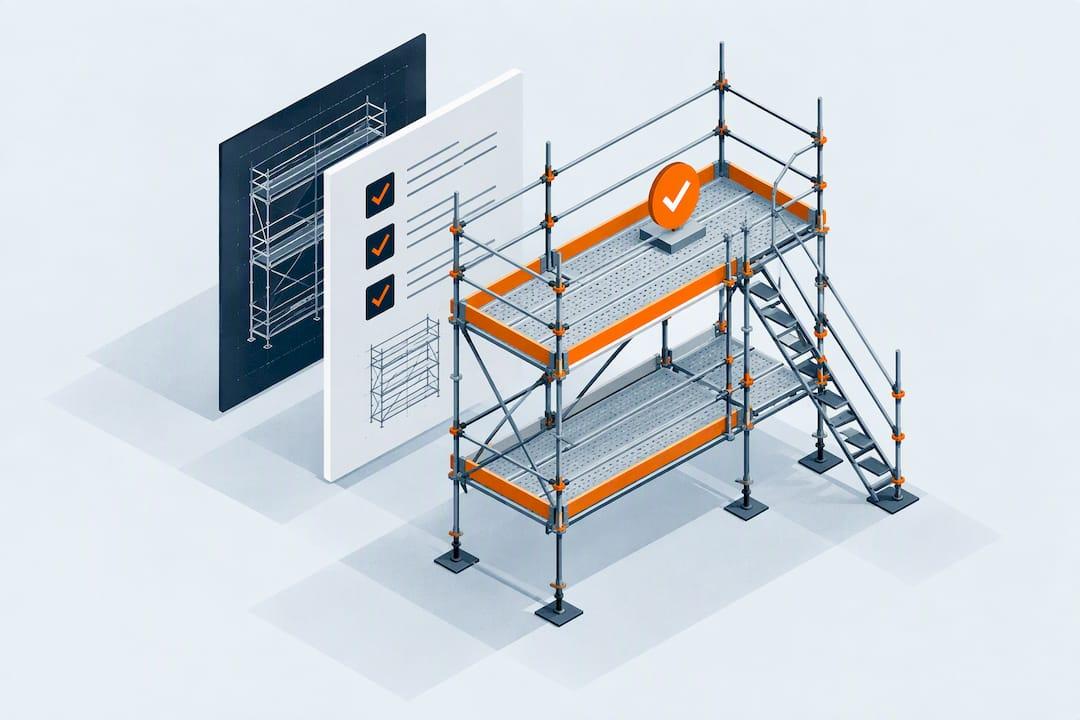
A scaffolding inspection checklist must confirm the structure still matches its design basis, from foundation to guardrails, and it must be completed before first use, at intervals of no more than every 7 days, and after any event that could affect stability. A competent person signs it off, and the findings get written down, not just remembered.
TL;DR:
- Regular inspections must be completed at least every seven days and after any event that might compromise stability, with findings properly recorded in writing.
- Inspections should match the scaffold’s design basis, checking foundation stability, component integrity, bracing, guardrails, access points, and load conditions with reference to original plans.
- Common defects include loose couplers, missing guardrails, damaged boards, and unstable bases, which require immediate cordoning off and documented remedial actions.
- Digital records that include photos, timestamps, and defect tracking can improve inspection traceability and ensure compliance over the scaffold’s lifetime.
- A competent person must sign off on each inspection report, which should document specific defects, actions taken, and be retained for project accountability.
Table of Contents
- Quick checklist: a compact summary for use on site
- Detailed checklist: systematic walkthrough by inspection area
- Inspection timing, legal requirements and who may sign off
- Recording, tags and digital records: making inspections auditable
- Common defects, immediate actions and when to prohibit use
- How digital scaffold management supports compliant inspections
- Author perspective: small habits that lift checklist effectiveness on site
- A digital option for streamlining inspection records
- Sources
- FAQ
Quick checklist: a compact summary for use on site
Keep a short version on a clipboard or phone for the walk-round, then expand into the full record afterwards. The header should capture the basics before you touch a single tube: date, time, site or project name, scaffold reference, and the inspector's name and signature.
From there, run through the top-line items in order:
- Foundation and sole boards: level, stable, no visible settlement.
- Standards, ledgers, transoms and couplers: tight, aligned, no corrosion or distortion.
- Bracing and ties: present where the design specifies them, properly fixed.
- Platforms and boards: fully decked, no gaps, no damaged boards.
- Guardrails and toe-boards: continuous along every open edge.
- Access and egress: ladders or stair towers clear and secure.
- Load limits, overhead hazards, weather and containment: checked against current site conditions.
Scaffold configurations should follow NASC TG20 or manufacturer guidance unless a bespoke design exists, which means the checklist is only as good as its comparison against that design basis.
Add a two-column section for defects found: one column for what you noticed, one for the action required, who owns it and by when. A scaffold tag can flag status at a glance, but it does not replace this written record.
Detailed checklist: systematic walkthrough by inspection area
Work from the ground up. A scaffold that looks fine at eye level can still be failing at the base.
- Foundation and base: check sole boards for cracking or sinking, confirm the structure is plumb, look for settlement or standing water, and note any excavation nearby that could undermine the footing.
- Standards, ledgers, transoms and couplers: confirm the right components are fitted in the right places, that couplers are tight, and that there is no bending, corrosion or missing hardware. Spacing and alignment should match the design drawing, not just "look about right".
- Bracing and ties: verify lateral restraint is adequate, that ties are fixed into sound structure, and that the bracing pattern matches what the design basis specifies rather than what happened to get installed.
- Platforms and boards: decking should be continuous with no gaps, boards secure, and no cracking, splitting or warping. Check board overhang and bearing at each end, since a board resting on too little support is a common source of failure.
- Guardrails and toe-boards: edge protection should run continuously, at the correct height, with mid-rails and toe-boards secured, not propped or missing on a "temporary" basis.
- Access and egress: ladders and stair towers should be stable and unobstructed, with gates or barriers at any opening that could otherwise let someone step off the edge.
- Load management: compare the load actually on the platform, materials, equipment, people, against the design load. Watch for signs of temporary overloading during hoisting or storage operations.
- Environmental and special checks: overhead electricity lines, wind loading on sheeted or netted scaffolds, containment systems, and mobile scaffold stability. Any mobile tower that has been relocated needs a fresh check before reuse, since reassembly often counts as a new installation.
Pro Tip: Carry the design drawing or configuration reference on the walkthrough itself. Comparing what you see against what was specified catches deviations that a purely visual check misses.
Inspection timing, legal requirements and who may sign off
The timing rule is straightforward: inspect before first use, then no more than every 7 days for the life of the scaffold, and again after any event likely to cause deterioration, adverse weather, impact, or alteration.
- Competence is configuration-specific: a basic scaffold may be assessed by someone who has completed a scaffold inspection course with relevant experience, while complex or bespoke structures need a specialist inspector, often trained through CISRS or an equivalent scheme.
- The written report should record the place inspected, any defects found, the corrective action taken, the inspector's identity, and the date, following the format set out in CIS47.
- Reports should be retained on site or accessible for the project's duration, since they form the compliance record if a query or incident arises later.
Recording, tags and digital records: making inspections auditable
A usable inspection record needs more than a tick box. It should show a timestamp, the inspector's identity, a clear description of any defect, the remedial action taken, and confirmation that the issue was closed out, ideally with photo evidence attached.
- Scafftags and similar visual tag systems are a useful supplement on site, but they do not replace the written report or the legal duty to record each inspection.
- Digital records add timestamped photos, location data, and named ownership for each defect, which makes the audit trail far easier to reconstruct later.
- A digital record that logs closure dates alongside the original defect gives a project a genuine trend history, rather than a stack of paper forms that get filed and forgotten.
- Automated reminders for the next 7-day cycle reduce the chance of a scaffold quietly running past its inspection window.
Common defects, immediate actions and when to prohibit use
Certain defects turn up again and again: missing or loose couplers, guardrails taken down and not replaced, damaged or missing boards, ties that have failed or were never fitted to the design, an unstable base, and unauthorised modifications made by trades working around the scaffold.
- Cordon off the affected area immediately and apply a clear "do not use" status.
- Notify the responsible person on site without delay.
- Record the defect and set a remedial deadline with a named owner.
Some defects need more than a quick fix. Structural instability, a significant deviation from the original design, or any doubt over what loads the scaffold can actually carry all call for removal from service or a formal engineering re-design, not a same-day patch.
Pro Tip: Never let a scaffold return to use on the strength of a verbal "it's sorted". Close the defect in the written record before anyone steps back on the platform.
How digital scaffold management supports compliant inspections
Having the original design and load limits available on site, rather than filed in an office, makes it far easier for an inspector to check the scaffold against its intended configuration instead of relying on memory or assumption.
Scaffold-er's 3D scaffold design tool and crew app keep the design plan, checklists and site photos in one place, updated in real time as work progresses. That means a competent person doing a 7-day check can compare what is standing against what was designed, log defects with photos on the spot, and hand the record straight to the next shift. Scaffold-er states that this integration reduces lost paperwork and improves traceability from design through to handover, a claim reflected in feedback shared on its demo feedback page.

Author perspective: small habits that lift checklist effectiveness on site
The checklists that actually work share one habit: every defect gets recorded, even the ones fixed in five minutes. That single line builds a pattern over weeks that a memory never will. Pair it with one named owner and one target date per defect, and a short handover note whenever a scaffold changes hands between gangs.
— Nik
A digital option for streamlining inspection records
Teams juggling paper checklists across several sites often lose time chasing down who signed what and when. There is a digital alternative available that offers a checklist tied directly to the 3D design, with timestamped photos and defect records that travel with the scaffold from erection to handover.

Plans start from £49, and the features page walks through how design and site records connect in practice.
FAQ
What is the basic scaffold inspection checklist?
A basic checklist covers the foundation and sole boards, standards, ledgers, transoms and couplers, bracing and ties, platforms and boards, guardrails and toe-boards, safe access and egress, and load limits. Each item is checked against the scaffold's original design or recognised configuration guidance, not just visually eyeballed.
What are the legal requirements for scaffolding inspection?
Scaffolds must be inspected before first use, then at intervals of no more than 7 days, and again after any event likely to cause deterioration, such as bad weather, impact or alteration. Inspections must be carried out by a competent person and the findings recorded in a written report.
What is required for scaffold inspections?
Each inspection needs a competent inspector, a systematic check against the scaffold's design basis, and a written report recording the place inspected, any defects, corrective action taken, the inspector's name and the date, as set out in CIS47. Scaffold tags can supplement this but do not replace the formal record.
What are the three most common scaffolding violations?
Frequent issues include missing or incomplete guardrails and toe-boards, damaged or poorly supported boards, and loose or missing couplers and ties that no longer match the original design. Any of these should trigger an immediate "do not use" status until remedied and recorded.